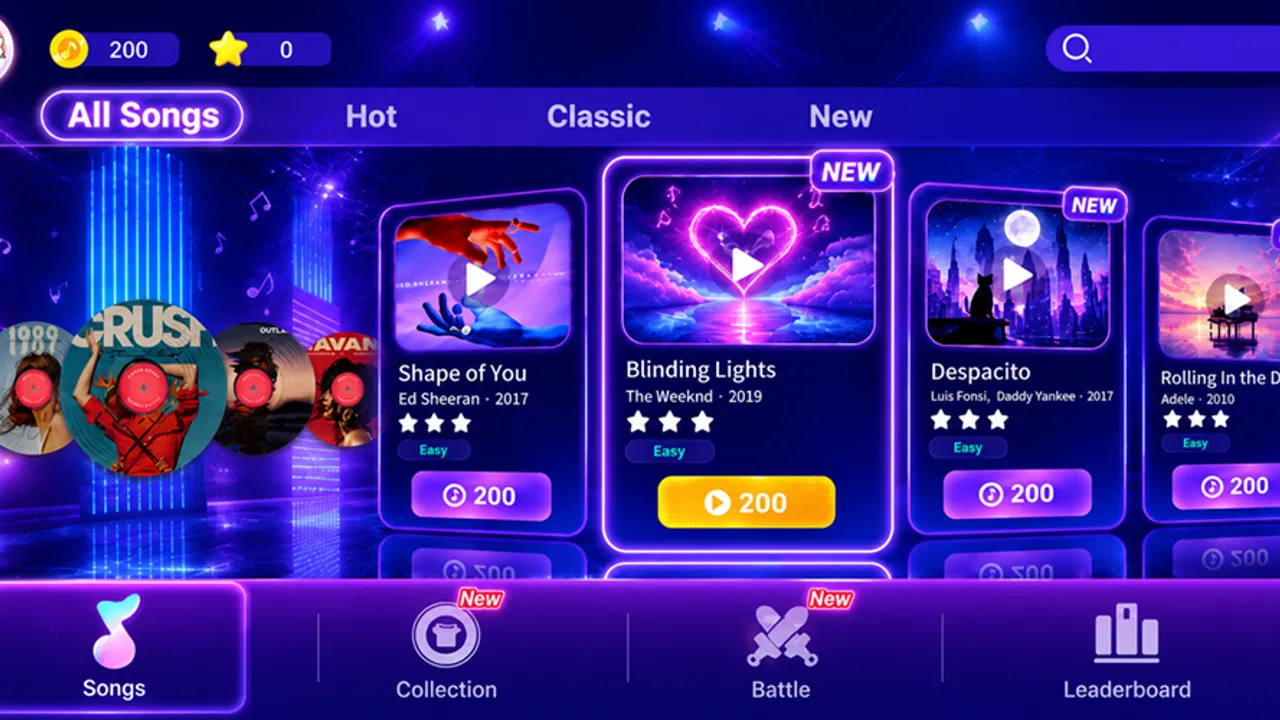
Magic Piano: Rhythm Challenge
- 4.3
- Rating
- 10.00M
- Installs
- Free
- Price

 Analysis by App-foxy
Magic Piano Music is the kind of game I open when I want a quick musical distraction rather than a deep strategy session. It turns piano playing into a reflex challenge: notes move toward a target area, and I tap them in time with the track. The appeal is immediate, especially when I am waiting somewhere or need a short break, but the experience depends heavily on how comfortable I am with repeated tapping and increasingly demanding patterns.
Developed by JMGame, this free music game is aimed at everyone rather than a specialist rhythm-game audience. It has reached over ten million installs and holds an average rating of 4.3 from around thirty-one thousand ratings, which gives a useful sense of its broad appeal. I would describe it as approachable, quick to understand, and easy to revisit, with optional in-app purchases ranging from ninety-nine cents to nine dollars and ninety-nine cents per item.
How the piano-tapping experience feels in everyday play
The first thing I noticed is how little time the game needs before it becomes understandable. There is no long learning curve in the basic interaction: watch the notes, tap accurately, and try to stay with the rhythm. That simplicity is a strength because I can start playing without studying a complicated control scheme. It also makes the game suitable for someone who has never played a rhythm title before.
You May Also Like

 Blood Strike: 2.5 Anniversary
Blood Strike’s Loadouts Turn Every Drop Into a Tactical Gamble
A close look at Blood Strike’s custom loadouts: how fast access to signature weapons reshapes its battle royale rhythm, rewards preparation, and narrows the gap between fights.

 Pandora - Music & Podcasts
Pandora’s Music Is Easy to Start, but Harder to Recover
Pandora’s strength is its low-effort path from a seed to a station. Its weak spot is how much confidence it asks you to place in connection, setup, and quiet recovery.

 8 Ball Pool
 Is Built on Rivalries, Rematches, and Routine
A close look at the rivalries, rematches, shared routines, and unanswered safety questions that turn a quick pool match into a persistent mobile community.

 Samsung Music
’s Quiet Strength Is Playing What You Already Own
Its reach comes less from spectacle than from dependable access to a personal library. That simplicity is both the app’s strongest retention engine and its ceiling.

 AccuWeather: Weather Radar
AccuWeather Review: A Quick, Clear Forecast for Everyday Decisions
For everyday plans, the best forecast is the one you can understand quickly. AccuWeather makes rain timing, radar, and local conditions easy to act on, with a few trade-offs.

 Hill Climb Racing
Why Hill Climb Racing Still Turns Crashes Into One More Run
A tiny car, a bumpy hill and one more upgrade: Hill Climb Racing keeps resurfacing because its simple chaos makes every near-miss feel personal.
More From Our News Desk
View All News


The challenge comes from maintaining concentration. A slow or familiar sequence can feel relaxing, while a denser passage demands more attention than the simple presentation initially suggests. I often find myself playing one round casually, then immediately trying again because I missed a note near the end. That retry instinct is central to the game’s appeal, although players who dislike repetition may find the loop narrow after longer sessions.
The piano theme gives the game a more focused identity than a generic tapping test. I am not managing a character, building a world, or solving a puzzle; I am trying to keep a musical flow alive. That makes it a good fit for short sessions during a commute, a break between tasks, or a quiet evening when I want something interactive without a large commitment.
The best way to judge it is as a compact rhythm challenge, not as a piano-learning tool. Successful taps may improve timing and hand-eye coordination, but the game is designed around performance and reaction rather than teaching notation, technique, or real keyboard skills. Anyone expecting structured music lessons should choose a dedicated learning app instead.
Speed expectations before a longer session
In my experience, the game feels most comfortable when I treat each round as a self-contained attempt. The opening interactions are easy to grasp, and the game’s straightforward design means I do not spend much time navigating before playing. That quick entry is important on a phone, where a game that takes several screens to reach the action can feel inconvenient.
As the patterns become more demanding, perceived speed changes even when the device itself is working normally. A sequence can feel fast because the spacing leaves less time to correct a mistake, not necessarily because anything is loading slowly. This distinction matters: if I miss notes during a busy passage, I first adjust my rhythm and finger placement rather than assuming the game is lagging.
For the smoothest experience, I keep my attention on the next few notes instead of looking too far ahead. Tapping too early is easy when I try to predict an entire sequence. A better approach is to use the visual movement as a guide, keep one finger ready in a comfortable position, and avoid changing grip halfway through a round. This small habit makes the game feel more controlled, especially during faster sections.
The game is free to start, so it is easy to test whether its pace suits me before spending anything. The optional purchases may appeal to players who want to support the developer or unlock whatever paid elements are offered in their current version, but I would not buy them simply to solve a timing problem. Practice and a stable grip have a bigger effect on my results than spending.
What happens during heavy-use moments
The most demanding moments are not necessarily long sessions. A short run can be more intense than several relaxed attempts because every tap requires attention. When I replay the same section repeatedly, the physical strain becomes more noticeable: my finger starts to tense, and accuracy drops even though I understand the pattern. Taking a brief pause is more useful than forcing another attempt immediately.
On a smaller phone, crowded patterns can also feel visually busier because the playable area leaves less room for comfortable finger placement. I prefer to hold the device securely with one hand and tap with the other, rather than covering too much of the screen with my thumb. A stand or stable surface can help when I am practicing, but it is not necessary for casual play.
Longer use may also make the game feel more demanding from a battery and attention perspective than its simple appearance suggests. I would not describe it as a resource-heavy visual game, since the core appeal is the rhythm interaction rather than a large animated world. Still, any game that keeps the screen active and asks for constant input can be tiring during extended play. I usually get more enjoyment from several short visits than from one uninterrupted marathon.
Another practical point is sound. Rhythm games are easier to judge when I can hear the music clearly, but playing in public or at night may require a lower volume or headphones. If the audio is difficult to hear, I rely more on visual timing, which makes fast passages less comfortable. That is not a flaw unique to this title, but it affects how well the piano theme works in real situations.
Reliability, recovery, and the value of a clean retry
Reliability matters more in a rhythm game than in many casual genres because a small interruption can ruin an otherwise successful attempt. I pay attention to whether the game returns me to the action smoothly after I leave it, receive a notification, or switch briefly to another app. The practical test is not only whether it opens, but whether I can recover without losing the sense of timing.
My preferred routine is to finish a round before switching away whenever possible. That reduces the chance of returning in the middle of a sequence and having to reorient myself. If the game does need to be reopened, I treat the next attempt as a fresh run rather than expecting to resume the exact musical moment. This is a sensible habit for short-session games and prevents a minor interruption from becoming frustrating.
Players should also remember that rhythm accuracy can feel like a reliability issue when the real problem is touch input. A damp screen, a thick protector, or a finger landing between targets can make taps seem inconsistent. Before blaming the game, I clean the display, use a lighter touch, and keep my tapping area clear. These checks are especially worthwhile when the same device behaves normally in other touch games.
The game’s current version is 4.1.5, and it requires Android 7.0 or later. That minimum requirement makes it accessible to many Android users, but compatibility on paper does not guarantee identical comfort on every handset. Screen size, touch responsiveness, background activity, and the age of the device can all affect how a rhythm game feels. I would test a few free rounds before deciding whether it deserves a permanent place on the phone.
Device constraints that can change the experience
Magic Piano Music does not need the visual complexity of a large three-dimensional game, which is one reason I see it as a practical choice for modest devices. Its central task is tapping to music, not rendering a detailed open environment. Even so, older hardware can influence startup speed, touch response, or how comfortably the game remains active after switching between apps.
Storage is another consideration, although I would not choose this game expecting a large collection of systems or a full music workstation. The important constraint is physical screen space. On a compact display, my finger can hide part of the play area, especially when I tap with the same hand that is holding the phone. A larger screen may make patterns easier to read, while a small phone is more convenient for quick play but less forgiving during busy sequences.
Notifications and background activity can affect concentration even when the game itself is stable. I get better results when I silence unnecessary interruptions and avoid playing while another demanding task is running. This is less about chasing maximum performance and more about protecting the timing window from distractions. For a game built around rhythm, a single unexpected interruption can matter more than impressive graphics ever would.
People using older Android phones should also consider touch latency. A slight delay between tapping and seeing a response can be difficult to separate from a missed note. If a device already feels slow in other rhythm or reaction games, this title may not fix that problem. A newer phone, a responsive screen, and a comfortable grip are more valuable here than extra visual effects.
Who will enjoy it, and who should choose something else
I would recommend it to casual players who like music-based challenges, quick retries, and games that explain themselves through interaction. It is also a reasonable first rhythm game for someone who wants to see whether tapping games are enjoyable before trying a more elaborate title. The Everyone age rating makes it easy to consider for a broad audience, although individual families should still decide whether repeated screen play fits their routine.
It works particularly well as a short break game. Imagine waiting for an appointment with only a few minutes available: I can play a round, stop without needing to remember a complicated storyline, and return later. The same applies to a quiet evening when I want something more active than listening to music but less demanding than a competitive multiplayer game.
I would skip it if my main goal were to learn piano properly, compose music, or explore a deep catalog with extensive customization. A music-learning app would provide structured lessons, while a larger rhythm game may offer more variety, progression systems, or competitive depth. This title’s strength is immediacy, so its limitations become clearer when I ask it to serve as something more ambitious.
Players who dislike repeated attempts should also think twice. The satisfaction comes from improving a run and keeping the sequence going, not from discovering a new story every few minutes. Likewise, anyone sensitive to optional purchase prompts should remember that the game is free but includes paid items. I prefer to decide in advance whether I am comfortable with that model instead of making an impulse purchase during a frustrating retry streak.
How it compares with ordinary alternatives
Compared with listening to a piano playlist, this game adds active participation but demands more focus. It is better when I want to do something with the music, and worse when I simply want to relax without watching the screen. Compared with a piano-learning application, it is quicker and more playful, but it does not replace lessons or real practice.
Compared with a large rhythm game, Magic Piano Music feels less intimidating. I do not need to understand a complex character system or spend time learning a broad set of mechanics before reaching the main challenge. The trade-off is that players seeking long-term depth may find the experience less satisfying once the basic tapping loop becomes familiar.
That balance is why I see it as a companion game rather than a single all-purpose music app. I can keep it available for short bursts and use a different title when I want deeper progression or a more serious musical purpose. Its value comes from being easy to enter, easy to retry, and focused on the immediate pleasure of matching taps to piano music.
My performance verdict after using it
Magic Piano Music succeeds when it stays within its natural role: a free, accessible rhythm game for quick musical sessions. The Android 7.0 minimum makes it reachable for users with a range of devices, while the simple presentation avoids the unnecessary weight of a visually elaborate game. I still would not assume every older phone will feel equally responsive, because touch latency and screen size matter greatly here.
My practical advice is to begin without purchasing anything, play during a few different situations, and judge three things: whether the notes remain comfortable to read, whether taps feel immediate, and whether the retry loop stays enjoyable after several attempts. If those answers are positive, the game is easy to recommend for casual use. If the screen feels cramped or the timing seems inconsistent, changing grip, cleaning the display, and reducing background interruptions are sensible first steps.
The developer, JMGame, has positioned the experience around a clear idea rather than a complicated package. That focus is both its advantage and its boundary. I enjoy it most when I want a fast musical challenge, but I would not choose it for formal piano training, elaborate progression, or a long narrative session.
Overall, I think it is worth trying for anyone curious about music games on Android who values quick access and simple controls. The free entry point lowers the risk, the broad age rating makes it approachable, and the established player interest suggests that the formula works for many people. My final recommendation is positive but specific: choose it for short, repeatable rhythm practice and light entertainment, not as a replacement for a piano teacher or a deeper rhythm platform.
FAQs for Magic Piano: Rhythm Challenge
01What is Magic Piano Music game about?
Magic Piano Music is an engaging rhythm-based game where players tap on tiles to play popular songs. The game offers a wide array of music genres, allowing players to enjoy classical pieces, pop hits, and more. As you progress, the game becomes more challenging, testing your reflexes and rhythm skills.
02Is Magic Piano Music free to play?
Magic Piano Music is free to download and play, but it contains in-app purchases. Players can buy additional songs, remove ads, or gain access to premium features. While you can enjoy many aspects of the game without spending money, some content may be restricted to paid users.
03What devices are compatible with Magic Piano Music?
Magic Piano Music is available for both Android and iOS devices. It requires a minimum of Android 4.4 or iOS 9.0 to run smoothly. Ensure your device meets these requirements to enjoy an optimal gaming experience with no lags or crashes.
04Can I play Magic Piano Music offline?
Yes, you can play Magic Piano Music offline. However, some features, like downloading new songs or accessing online leaderboards, require an internet connection. Offline play is perfect for enjoying the game on-the-go without worrying about data usage.
05How often is new content added to Magic Piano Music?
The developers regularly update Magic Piano Music with new songs and features. Updates may vary in frequency, but they aim to keep the game fresh and exciting. Keep an eye on app updates to enjoy the latest content and improvements.
Pros
- Intuitive controls make playing easy.
- Wide variety of songs available.
- Regular updates with new tracks.
- Offline mode for uninterrupted play.
- Engaging graphics enhance experience.
Cons
- In-app purchases can be costly.
- Ads may interrupt gameplay.
- Some tracks require premium access.
- Limited customization options.
- Occasional lag on older devices.

Magic Piano: Rhythm Challenge
Gallery